// the retrieval
How search works
Find a useful starting point, then follow the context and evidence around it. Each step has a job; the graph does not answer a question by itself.
// retrieval flow
Find an entry point. Then inspect its connections.
arrows = the next retrieval step · lit = inspecting the source and its trust
- Resolve Exact paths and aliases identify records; ambiguous names remain candidates rather than being silently merged.
- Rank Word matches in titles, aliases, summaries, bodies and grouping context produce candidate pages. Common metadata keys are excluded from body terms.
- Navigate Inspect the candidate’s groups, backlinks and supported typed relations. A reader or calling agent chooses which routes to follow.
- Read Open the evidence and keep its authority, inference, review state and freshness visible.
- Select Choose a bounded set of relevant sources for the task. Search and navigation do not establish semantic answer correctness.
Download the search flow SVG ↓
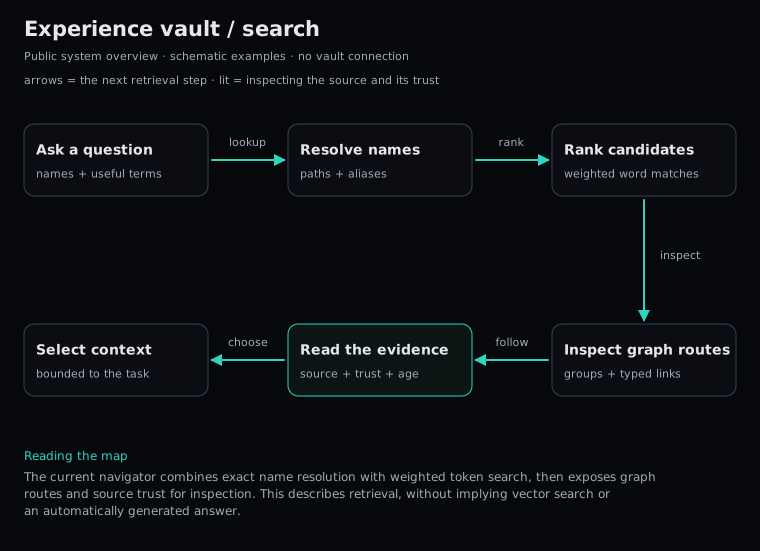
A graph needs a retrieval policy. Candidate search finds places to begin; graph navigation exposes useful context around them. The final step is to inspect the source and choose what the task actually needs.
// candidate pages
Resolve names and rank useful words.
The current vault resolves exact names and known aliases, then uses word-based ranking across titles, aliases, summaries, labels, group context and body text. More informative terms and fields receive more weight. Metadata field names stay out of body terms.
Group and theme filters can narrow the search. A grouping page can itself be a useful result: it offers an entry into an area before the reader knows the right topic name.
// local exploration
Expand with a reason.
Follow memberships for context, parents for the broader view, linked pages for neighbors and source links for evidence. Backlinks show where a page is used. Relation kinds and a small hop budget keep exploration bounded.
Read the original account and its trust label before turning it into an answer. Reaching a source is an access result; deciding whether it supports a claim still takes inspection.
An LLM can use the selected context and cite what it read. The retrieval described here uses lexical indexing and graph navigation. Vector search and model-generated answers are separate choices.
// a synthetic example
Try a small, made-up graph.
Search the example, select a result and follow a connection. Every record below is synthetic. The demonstration runs entirely in the browser and has no connection to the actual vault.
Synthetic example · no private vault connection
Try a phrase, choose a match, then follow its groups or evidence. Every note here was made up for this page.
01 · find an entry point
4 matching example notes
02 · follow the connections
Retries
When to repeat an operation after a failure, and how to limit the attempt.
Unreviewed example · a label in this fictional dataset
One-hop links
Recent route
- Retries
Search ranks words in titles, aliases and summaries. Links then open broader groups, related topics or evidence. This small demonstration runs entirely in your browser and produces no generated answer.