// the connections
The knowledge graph
A knowledge graph names the things worth keeping, the relationships between them and the context needed to read those relationships.
// three parts
The connections carry meaning.
- Nodes: things worth naming
- A topic, project, lesson, source or grouping page. A canonical identity keeps a subject recognizable when its display name changes.
- Edges: named relationships
- One page links to another, belongs to a group or is part of a broader theme. An explicitly supported semantic relationship can say more.
- Metadata: context around a record
- Type, summary, aliases, labels, source, freshness and trust help a reader decide what to open and how to interpret it.
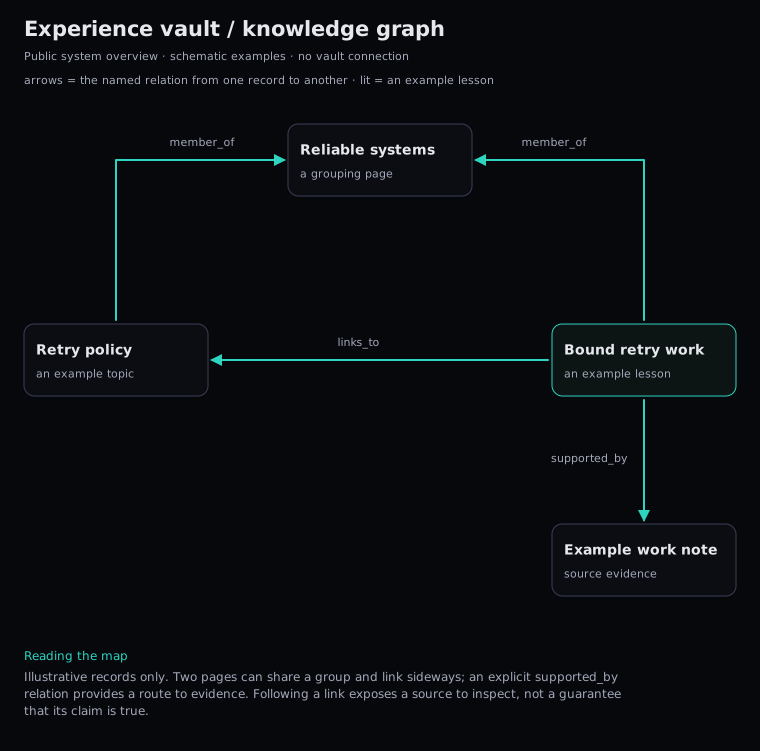
arrows = the named relation from one record to another · lit = an example lesson
- Group The invented topic Retry policy and lesson Bound retry work each belong to the Reliable systems grouping page.
- Cross-link The lesson links sideways to the topic; their shared group supplies another route between them.
- Inspect evidence The lesson has an illustrative supported_by relation to an invented work note. Its evidence and trust labels still need to be read.
- Enter anywhere Start at a group, topic, lesson or source. Follow outgoing relations, backlinks or inverse membership to discover wider context.
// progressive discovery
A hierarchy inside a web.
Grouping pages provide broad-to-narrow routes. Cross-links connect useful neighbors. A topic can belong to several groups, and a reader can enter at any page.
Depth belongs to the path. The same lesson might sit near the surface of a project overview and deeper in a broad engineering theme. There is no single reading level permanently assigned to every page.
The group hierarchy has no parent cycles. Ordinary cross-links can form loops, so navigation uses deliberate routes and bounded exploration.
// entity resolution
Resolve identity before joining things.
A canonical page is the chosen home for a subject. Known aliases point to that identity, and explicit rename records preserve it when a path changes. A similar-looking name alone does not justify merging records.
When a name could mean several things, the candidates stay visible for review. Missing or ambiguous references retain their original query and a route into a review record. That route makes the gap inspectable; it does not invent the missing knowledge.
// closed relationship vocabulary
Say which connection you mean.
links_to- A page has an ordinary link to another page.
member_ofandpart_of- A record belongs to a group, or a group/page sits under a broader structural parent.
applies_to,supported_byandused_in- Declared semantic connections can identify relevant context, supporting evidence or a place an idea was used.
contradicted_by,supersedesandinspired_by- Other declared connections can preserve contrary evidence, replacement or an originating influence.
Having a relationship type available does not assert that relationship. Semantic edges need declared support. Communities discovered from graph structure remain proposals until a separate decision adopts them.