// the system
The architecture
Sources, generated records and authored guidance stay distinct. The graph connects them, and retrieval brings a bounded part back to a question.
// the flow
From working context to something I can use.
arrows = inputs read by the next component · lit = hand-authored guidance
- Collect Work records and source notes provide evidence for the record.
- Summarise Bounded, cached model calls produce structured accounts. Hand-authored guidance is a separate input, with its own authority.
- Render and index Rebuildable notes receive metadata, identities, links and grouping routes; the index makes those routes searchable.
- Retrieve A reader or calling agent searches, inspects and selects source context, including authored guidance directly. Privacy and publication checks govern what may leave the system.
Download the architecture SVG ↓
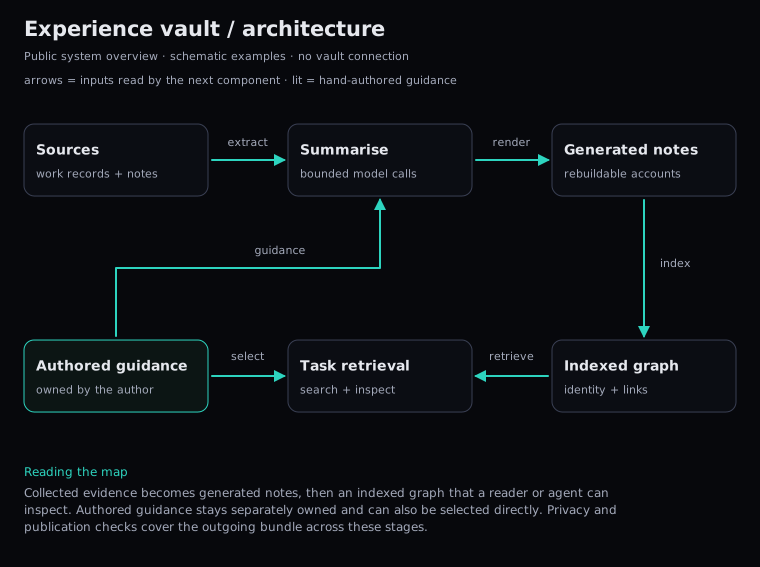
Collected evidence becomes generated notes, then an indexed graph. Authored guidance keeps its own ownership and can be selected directly for a task as well as informing summarization. Privacy and publication checks cover outgoing content across these stages.
// ownership
Each kind of record has a different job.
Source records preserve the account behind the work. Generated pages make that account easier to scan and connect. Authored notes hold what I write, correct or explicitly adopt.
A producer updates its own outputs. It must not silently rewrite protected context or convert a generated interpretation into an approved personal view. Retrieval keeps those labels alongside the selected material.
// component responsibilities
The systems around the graph.
Sources
Capture the account
- Chat collection
- Collect the relevant working conversations from supported sources.
- Repository intake
- Bring selected documentation and change context into the source record.
- Source caches
- Keep reusable input separate from the pages rendered from it.
- Manual capture and interviews
- Add knowledge that never appeared in a chat, with the owner reviewing the account.
Processing
Build useful records
- Summarization
- Extract work, decisions and lessons through bounded model calls.
- Cache and spend controls
- Reuse unchanged results and bound the cost of a run.
- Page producers
- Render consistent project, work, wiki and timeline pages.
- Authored context
- Keep personal notes and approved guidance under a different ownership contract.
Organization
Connect the knowledge
- Versioned metadata
- Declare page type, schema, summary, known aliases and relevant labels.
- Identity and resolution
- Resolve exact names and aliases to canonical pages; preserve ambiguity for review.
- Typed links and grouping pages
- Represent navigation, membership and supported semantic relationships.
- Theme discovery
- Propose graph communities with stable identities; adoption remains a separate decision.
Retrieval
Find and use context
- Lexical search
- Rank terms across titles, aliases, summaries and note bodies.
- Graph navigation
- Move through groups, parents, neighbors and backlinks.
- Task briefings
- Select bounded context for a task and retain the exact versions used.
- Agent instructions
- Apply the relevant rules to a task while preserving source and trust labels.
Governance
Keep the boundaries clear
- Writing and code rules
- Keep documents, code, diagrams and agent workflows consistent.
- Integrity checks
- Check schemas, links, identities, ownership and generated-output freshness.
- Privacy screening
- Screen names and secrets, hold uncleared files and check outgoing versions.
- Public release review
- Apply a separate public-content boundary before selected material leaves the private system.
Operations
Make the next run ordinary
- Bounded rebuilds
- Regenerate dependent views until checks agree, or stop within a fixed limit.
- Review queues
- Keep uncertain references, proposed changes and missing information visible.
- Evaluation and CI
- Exercise retrieval tasks and failure cases instead of treating a green render as proof.
- Component inventory
- Record components, interfaces, dependencies, tests and gaps; derive overview diagrams from maintained data.
These are responsibilities, not a live host-status report. Connected navigation and the newer maintenance work are built in development and remain under review.
// main areas
Different kinds of memory.
- My notes · Authored
- What I write, correct or explicitly adopt: context, ideas and accounts of what I know. A generated page cannot silently turn its interpretation into my view.
- Projects and work · Generated record
- What was built, the decisions along the way, alternatives, outcomes and the work that remains. Each account keeps a route back to its sources.
- The wiki · Connected knowledge
- Tools, methods and ideas encountered across projects. A topic can connect to several projects and lessons while keeping stated and inferred views distinct.
- Groups and themes · Navigation
- Grouping pages collect related material and can nest under broader themes. Maintained groups are separate from communities proposed by graph analysis.
- Lessons and rules · Reusable guidance
- Lessons carry the case that taught them. Rules explain the behavior to follow, why it exists and which check or review can hold it.
- Evidence and time · Source trail
- Work notes, experiments and a timeline preserve the context behind a claim. A short summary is a way in; the underlying account is still available to inspect.
- Review and operations · Maintenance
- Queues, schemas, checks, component maps and change records make missing information and unfinished work visible instead of smoothing them away.
- Public writing · Separate output
- Selected, reviewed explanations can become articles or lessons. This page is a curated system description; the private graph and its records stay outside this website.